Health Testing
Breeding and Working Dog Health Clearances
Purpose-bred dogs require thoughtful, objective health screening. Health clearances are part of responsible dog ownership, ethical breeding, and long-term preservation of breed health, structure, function, and temperament.
At Bristol Veterinary Clinic, we offer health-clearance services for breeders, working-dog handlers, performance homes, and owners who want meaningful information about their dog’s orthopedic and inherited health risks. Whether you are preparing for a breeding decision, meeting parent-club recommendations, completing working-dog documentation, or simply trying to better understand your dog’s health, we provide careful testing, high-quality imaging, accurate documentation, and honest guidance.
Many of our clients share their lives with dogs who are more than beloved pets and family members. Their dogs are athletes in peak physical condition, breeding prospects, working partners, and representatives of their breed. These dogs deserve health testing performed with the same level of care and purpose their owners put into their training, conditioning, breeding, and handling.
Why Health Clearances Matter
Health clearances give you knowledge and knowledge is power.
Testing can help identify inherited, developmental, and structural concerns before the condition can limit a dog’s comfort, performance, or quality of life; Or before those issues are passed to the next generation.
No health test can guarantee a perfect outcome, but it stacks the odds in favor of the best outcome. Appropriate health screening gives breeders and owners information to reduce risk, guide breeding decisions, support early intervention when appropriate, and contribute to stronger long-term data within a breed.
For ethical breeders, health clearances are part of stewardship of their breed. Properly performed health clearances protect the future of a breed by prioritizing dogs who possess more than beauty in the show ring or talent in a sport. Health testing allows breeders to select dogs who are healthy and physically functional and sound.
For working and performance dogs, health clearances provide valuable information about orthopedic soundness and potential risk factors before a dog is asked to rigorously train, strenuously compete, or enter a demanding career in their chosen sport.
Health testing is not about chasing certificates. It is about making informed decisions with the best information available.
Breeder-Focused Veterinary Care
Bristol Veterinary Clinic is uniquely positioned to support responsible breeders because we understand the purpose behind health testing.
Dr. Player is both a veterinarian and an ethical, preservation-minded breeder. She understands the importance of breed standards, correct structure, sound movement, solid temperament, genetic health, and making careful breeding decisions based on more than convenience or appearance.
That perspective is not limited to Dr. Player: members of the BVC team are also actively involved in ethical and preservation breeding based on breed standards, health testing, proper temperament, and responsible placement. Our team understands the time, planning, expense, and emotional investment required for a responsible breeding program.
We respect breeders who are trying to do things correctly. We also understand health-clearance appointments are not “just X-rays” or “just paperwork.” Positioning, timing, documentation, submission requirements, breed-specific expectations, and the long-term implications of the results all matter.
BVC helps you navigate that process with care and accuracy.
OFA Testing
The Orthopedic Foundation for Animals, commonly known as OFA, maintains health-screening databases used by breeders, breed clubs, veterinarians, and owners to support informed breeding decisions and reduce the incidence of inherited disease.
Many people think of OFA testing as “hips and elbows,” but OFA clearances include so much more. Depending on the breed, OFA testing may involve radiographs requiring specific positioning, physical examination, laboratory testing, genetic test result submission, examination performed by a board-certified veterinary specialist, or a combination of these.
OFA Radiographs
BVC offers OFA radiographs for orthopedic evaluations commonly used in breeding and working-dog programs, including:
- Hips
- Elbows
- Shoulder Osteochondrosis (OCD)
- Spine
- Tracheal hypoplasia
- Legg-Calve-Perthes
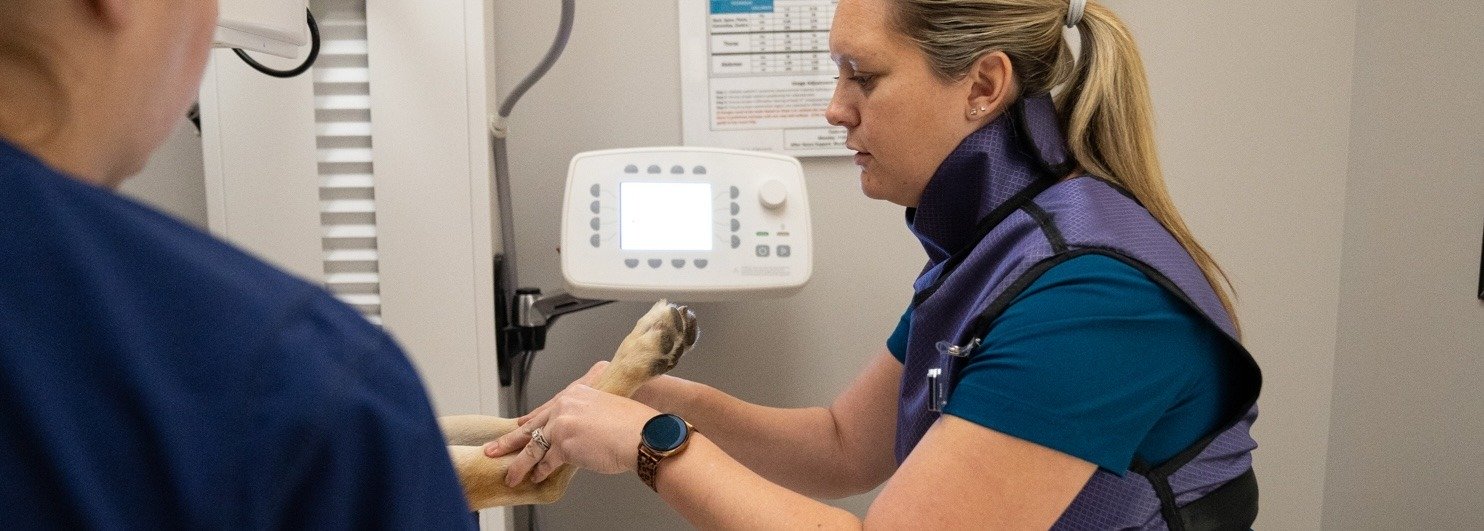
OFA does not require special certification for a veterinarian to perform and submit radiographs. Unfortunately, not every veterinarian is equally skilled at obtaining proper OFA positioning.
And positioning matters. A lot.
Poor positioning can cause a structurally normal, healthy dog to appear abnormal. Improper positioning can obscure important anatomy, cause unnecessary repeat imaging, reduce the usefulness of the evaluation, or affect how the study is interpreted. Anatomical symmetry, limb placement, pelvic alignment, exposure quality, patient relaxation, and careful attention to submission requirements all influence the quality of the final radiographs.
Health testing should identify dogs with legitimate orthopedic or structural abnormalities. It should never penalize a dog because the radiographs were poorly positioned or technically inadequate. An inaccurate or compromised study can affect a dog’s future in breeding, sport, or work. It can also impact a breeder’s reputation, breeding options, and long-term breeding program decisions.
At BVC, we take OFA positioning seriously because the image is the foundation of the evaluation – The diagnosis can only as good as the diagnostic!
Additional OFA Clearances We Can Help With
OFA testing extends well beyond radiographs. BVC can assist with a variety of laboratory submissions, physical exam evaluations, and database documentation used in breeding and working dog programs, including:
- Thyroid Database Testing
- Basic Cardiac Database Evaluation
- Dentition Database Evaluation
- Patellar Luxation Database Evaluation
- Respiratory Function Grading Scheme (RFGS) Evaluation
- Kidney Database Testing
- Serum Bile Acid Database Testing
- Sebaceous Adenitis Database Testing
- CHIC DNA Repository Submission
- DNA Based Genetic Database Testing
- Verification of Permanent Identification
Specialist OFA Clearances
Certain health clearances require specialist evaluation.
OFA testing requiring completion by a board-certified veterinary specialists include:
- Advanced Cardiac Evaluation - Cardiologist
- Holter Evaluation – Cardiologist
- CAER Eye Certification – Ophthalmologist
- Gonioscopy Certification – Ophthalmologist
When a test requires a specialist, we work with trusted referral partners to help clients complete testing appropriately. We are thoughtful about these referrals because breeding and breed-specific health clearances require both technical expertise and an understanding of the conditions most relevant to each breed.
We refer clients to specialists who share our goals in breed stewardship and who are experienced, thorough, and comfortable evaluating dogs as part of responsible breeding programs. These specialists appreciate the larger picture of a breeding program and understand accurate interpretation matters.
We value specialists who interpret diagnostics with appropriate clinical perspective without minimizing legitimate concerns or overextending minor findings beyond their medical and genetic significance. Their recommendations are thoughtful, proportionate, and grounded in the needs of the individual dog and improvement of the breed.
OFA Health Clinics and Super Clinics
PennHIP Evaluations
PennHIP utilizes specialized radiographic positioning to evaluate canine hip laxity and assess risk for the development of hip dysplasia and osteoarthritis.
Unlike a standard hip-extended radiograph, PennHIP uses a specific series of radiographs to measure passive hip laxity, an important predictor of a dog’s risk to developing hip dysplasia. This series produces a quantitative measurement called the distraction index, which compares an individual dog’s measured hip laxity to others within the breed. This provides valuable information for showing, working, breeding, and orthopedic decision-making.
PennHIP is especially valuable because it can be performed as young as 16 weeks of age, giving breeders, owners, and working-dog handlers objective data early in a dog’s life, well before significant training, financial investment, or breeding decisions are made.
PennHIP is not something any veterinarian can simply decide to offer. Veterinarians must complete specialized training and certification before they are approved to perform and submit PennHIP radiographs.
At BVC, PennHIP evaluations are performed with attention to:
- Patient safety
- Proper patient relaxation
- Required PennHIP positioning
- Safe and accurate use of the PennHIP distractor
- Image quality
- Clear communication of results and their meaning
PennHIP can be helpful for breeding dogs, working dogs, performance dogs, and young dogs whose owners want earlier objective information about hip laxity and future orthopedic risk.
ADRK Radiographic Positioning
Some breeds and international registries have radiographic positioning expectations beyond standard domestic OFA or PennHIP submissions.
For Rottweilers and other dogs pursuing international or registry-specific documentation, ADRK-style radiographic positioning may be required or preferred as part of the health-clearance process. This type of imaging requires careful attention to the registry’s expectations, required views, positioning standards, identification requirements, and submission instructions.
Bristol Veterinary Clinic plans to expand breed-specific and registry-specific radiographic support, including ADRK radiographic positioning, for clients pursuing these clearances.
ADRK Positioning is Coming Soon!
Scheduling Health Clearance Appointments
Health-clearance appointments often require planning before the day of the visit.
Depending on the type of testing, your dog may require sedation, anesthesia, fasting for a specific amount of time, timing around a vaccination, or timing around a bitch’s heat cycle.
Proper completion of the test may require microchip verification, verification of registration information, completed application forms, laboratory submission paperwork, specialist scheduling, or completion at a specific age based upon breed, registry, or OFA/PennHIP requirements.
When scheduling, please let us know which clearances your dog needs and whether the testing is for OFA, PennHIP, a parent club, CHIC requirements, a working-dog program, or an international registry.
Please bring or provide your dog’s:
- Registration certificate
- Registered name
- Registration number
- Microchip number
- Date of birth
- Breed
- Any required OFA, PennHIP, parent-club, or registry forms
- Prior health-testing results, if applicable
- Any specific submission instructions from your breed club or registry
For breeders completing multiple clearances, we are happy to help coordinate testing when possible and guide you through which services can be completed at BVC and which require specialist involvement.